


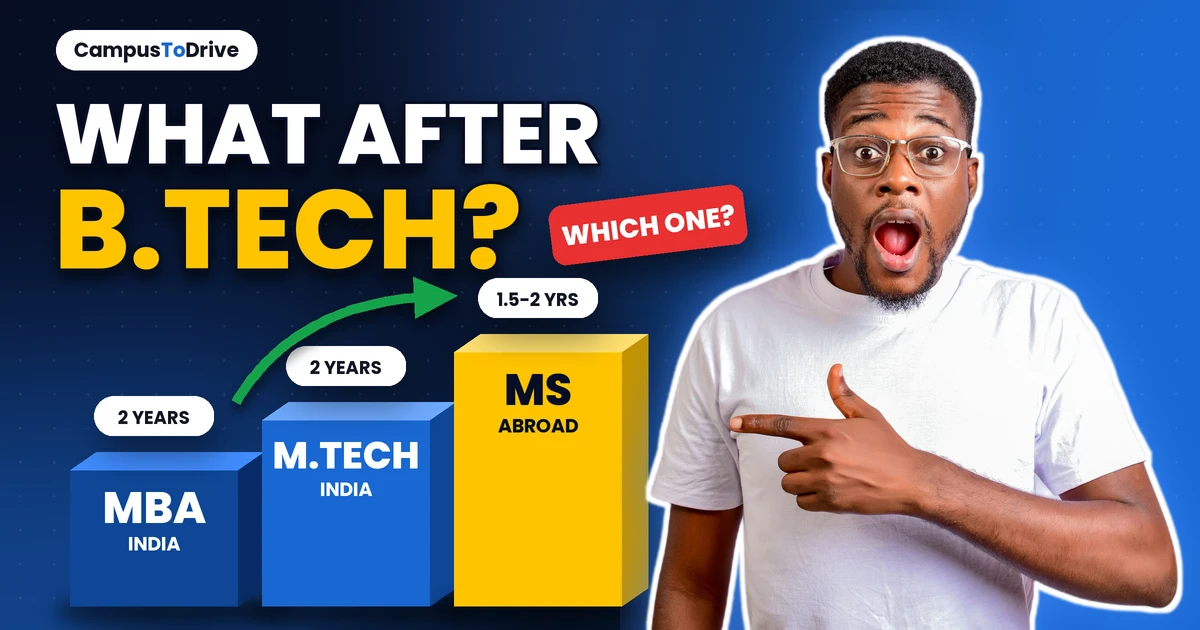
Wondering what to do after B.Tech? After completing a B.Tech, you can choose to get a job, pursue an MBA, pursue an M.Tech in India, or pursue an MS abroad. The decision will depend on your interests, how much money you have available, and what your career goals are.
MBA vs M.Tech vs MS Abroad vs Job: Quick Comparison
| Parameter | MBA (India) | M.Tech (India) | MS Abroad | Get a job |
|---|---|---|---|---|
| Focus | Management | Advanced technical knowledge | Specialised knowledge | Work experience |
| Duration | 2 years | 2 years | Usually, 1 to 2 years | No set duration |
| Entry Requirements | CAT/XAT/other exams | GATE/Institution specific | University requirements and English proficiency requirements | Employer selection |
| Cost | Few Lacs to 25 Lacs+ | Varies. May have funding. | Often 25-60 Lacs+ (including living costs) | Usually, no cost |
| Career Direction | Consulting, Finance, Product Management, Management | Engineering, Research | Specialised technical/research | Entry level roles in industry |
MBA After B.Tech: Is It Right for You?
If you want to progress into business, management, consulting, finance, product management or operations within your studies, an MBA after B.Tech may be suitable. Previous technical knowledge may be useful within technical businesses.
MBA Eligibility and Entrance Exams (CAT, XAT, GMAT)
Most courses require a recognised bachelor’s degree such as a B.Tech or B.E. Minimum grades and selection processes will depend on the institution. Some courses may not require work experience, however having between 1-3 years’ experience may strengthen your application.
Popular MBA entrance exams include: CAT, XAT, CMAT, MAT, NMAT, SNAP, GMAT. Acceptance into courses will vary depending on the institution. Check the institution’s website for the latest dates and entry requirements.
Popular MBA Specialisations and Careers for Engineers
Popular specialisations include Finance, Marketing, Human Resource Management, Business Analytics, Operations, Supply Chain Management, Information Systems, and Product Management. Depending on specialisation and recruitment, you may find roles including Business Analyst, Management Consultant, Financial Analyst, Product Manager or Operations Manager.
Popular MBA colleges in India include IIMs, XLRI, and FMS Delhi. Be sure to compare the course content, cost, selection criteria and placement reports of different institutions to make an informed decision.
M.Tech After B.Tech: GATE, Eligibility and Scope
If you wish to gain advanced technical knowledge, specialise in a technical field, or pursue certain academic careers, M.Tech after B.Tech may be suitable.
M.Tech Eligibility and GATE Exam
A common entry requirement is the GATE exam. The eligibility, papers accepted, cut off marks, and selection process will depend on the current GATE guidelines and the specific institution.
Many IITs, NITs and other institutions use the GATE score for M.Tech admission. Whether you apply via COAP or CCMT depends on the institution. Be sure to check which process applies to your desired institution.
Popular M.Tech Specialisations and Careers
Popular M.Tech specialisations include Computer Science, AI, Data Science, VLSI, Embedded Systems, Power Systems, Structural Engineering, and Thermal Engineering.
Depending on specialisation, you may wish to pursue advanced engineering, semiconductor design, software development, research or teaching. Depending on eligibility, you may find financial support within the institution.
Note: GATE scores may be used for recruitment to certain PSUs. This is separate from entry into the M.Tech course, and the rules will vary depending on the organisation.
MS Abroad After B.Tech: Cost, Eligibility and Top Countries
If you wish to specialise in a certain subject and can budget for the cost, living expenses, and visa requirements, pursuing an MS abroad after B.Tech could be suitable.
Best Countries for MS After B.Tech for Indian Students
| Country | Information to consider |
|---|---|
| USA | Wide range of universities and research opportunities. However, total cost can be expensive. |
| Germany | Tuition can be cheaper at public universities. However, living costs and course requirements apply. |
| UK | Many courses can be completed in 1 year. |
| Canada | Technical courses. Check current study and work rights. |
| Australia | Postgraduate options in engineering and technology. Compare costs of tuition and living. |
Choose a country depending on quality of course, duration, affordability, and future career.
MS Abroad Eligibility: SOP, IELTS/TOEFL and GRE
You may be required to submit transcripts, a statement of purpose (SOP), references, a CV, and examples of projects/research. You may be required to take IELTS/TOEFL.
GRE requirements vary depending on the course. Check the admissions page of the department.
MS Abroad Scholarships, Assistantships and Total Cost
Look for scholarships and assistantships. Be aware of the total cost of the course (tuition, living costs, insurance, travel, visa). Be aware of new changes to work rights after study. Check official government sources. Research demand for your specialisation. Just because you have an international degree does not guarantee you a job.
MBA vs M.Tech vs MS Abroad: Salary, Career Progression and ROI
Be sure to consider ROI, rather than the highest salary. Consider how many people graduated from the course, what roles they got and the overall cost of the course.
Consider:
Total Cost
Tuition, accommodation, travel costs, exam fees, insurance and other costs.
Placements
Median salary, placement rate, number of people in the batch and types of roles.
Opportunity Cost
Lost income during study.
Relevance to Career
Ensure that the course and specialisation will help you in your desired role.
Career Progression
Consider progression, demand in industry, and opportunities to gain valuable skills.
Refer to official placement reports. Salaries will vary depending on institution, location, experience and industry. Do not assume the highest package.
Best Higher Studies Option by B.Tech Branch (CSE, ECE, Mechanical, Civil)
Whilst certain specialisations may be more relevant to your branch, you may still be able to pursue any career.
| B.Tech Branch | Potential further study options |
|---|---|
| Computer Science (CSE) | M.Tech (CSE/AI/Data Science), MS (Computer Science), MBA |
| ECE | VLSI, Embedded Systems, Communication, MS (Electrical Engineering) |
| EEE | Power Systems, Control Systems, Renewable Energy, MBA |
| Mechanical | Robotics, Automotive Engineering, Manufacturing, MS (Mechanical Engineering) |
| Civil | Structural Engineering, Construction Management, MS (Civil Engineering) |
| Chemical | Process Engineering, Materials Science, MS (Chemical Engineering) |
| BioTechnology | BioTechnology, BioInformatics, Biomedical Engineering, MBA |
Be sure to check entry requirements, and seek advice from faculty members, alumni and professionals.
Job After B.Tech or Higher Studies First?
Getting a job after your B.Tech can give you income, and expose you to industry. It may also help you decide whether you require postgraduate qualifications. If you are looking for fresher roles, see our guide on how to find and verify off-campus drives.
Having 1-2 years of experience can be useful to strengthen certain MBA applications. However, if you have clear plans, meet the requirements, and can fund the course, it may be best to begin further study straight away. Getting a job can help you save money, and prepare for entrance exams.
How to Choose Between MBA, M.Tech and MS Abroad
Ask yourself:
- Are you more interested in technical or business roles?
- Can you afford this course?
- Where do you want to progress your career?
- Will this course allow you to get your desired role?
- Will gaining work experience help you make a decision?
Research at least 3 options. Compare entry requirements, costs, course content, placement data, funding and deadlines. Ask students or alumni for information. Make an informed decision based on evidence.
Frequently Asked Questions: Higher Studies After B.Tech
What are the options after B.Tech?
After B.Tech, the main options are getting a job, doing an MBA, doing an M.Tech in India, or doing an MS abroad. Your interests, budget and career goals should decide which one suits you.
What is better to do after B.Tech, MBA or M.Tech?
Depending on your desired career, choose between MBA (management) and M.Tech (technical specialism).
Is MBA or MS better after B.Tech?
Choose MBA if you want management, consulting, finance or product roles. Choose MS if you want deeper technical or research knowledge in your field.
Is GATE required to get into M.Tech?
GATE is a common method of entry. However, depending on the institution, there may be alternative methods. Be sure to check entry requirements and eligibility for the specific institution.
Do I have to take GRE for MS Abroad?
No. It depends on the university and course. Some require it, some make it optional, and some do not accept it.
Is MS Abroad a good investment?
It can be a good investment if the course, university, funding and career opportunities match your goals. Be sure to consider the total cost, availability of roles in industry, and current visa regulations.
Can I do MBA after B.Tech without work experience?
Some MBA courses do not require work experience. However, having 1-3 years of experience may strengthen your application. Check the eligibility of the specific institution.
Which country is best for MS after B.Tech?
There is no single best country. Compare course quality, duration, affordability and career prospects. Germany can have lower tuition at public universities, and many UK courses can be completed in 1 year.
Can I get a job after B.Tech and do further study later?
Yes. Once you have gained experience in a job, check the eligibility requirements for the course.
Conclusion: Which Is Best After B.Tech?
There is no one ‘best’ option to do after your B.Tech. An MBA can help with management roles, M.Tech can improve technical knowledge, and an MS Abroad can provide international study. A job can give you income and experience. Consider your interests, money, and career goals. Do research to make an informed decision.
Note: Entry requirements, exam requirements, tuition fees, scholarships, placement data and immigration rules may change. Check for the most up to date information from official exam boards, universities, and government websites.
For more fresher jobs, internships, and off-campus drives to start your career after B.Tech, visit CampusToDrive.



[…] For research-heavy roles at top labs, often yes. For analyst, AI application and junior ML roles at most Indian companies and startups, a solid portfolio and interview performance matter more. If you’re considering further study, read our higher studies after B.Tech guide. […]