


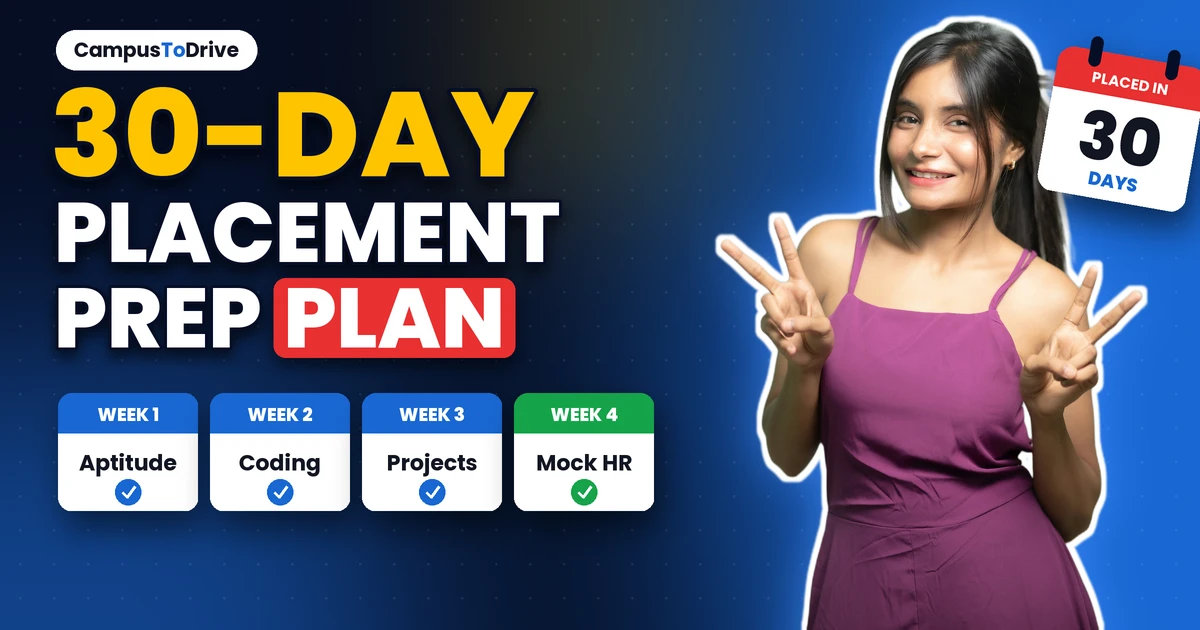
Thirty days isn’t a lot of time. But it’s enough to go from “I don’t know where to start” to walking into a TCS, Infosys or Accenture assessment feeling ready. The catch is that you need a plan you’ll actually follow, not one that looks impressive on day one and is abandoned by day four.
Here’s what that plan looks like. It assumes about 3–4 hours a day alongside college.
Before day 1: a 30-minute reality check
- List the 5–10 companies you’ll realistically apply to.
- Look up their test pattern. Most mass recruiters test aptitude, logical reasoning, verbal ability and 1–2 coding questions.
- Take one free mock test without preparing. Your weakest section is where the extra time goes.
1st Week – Aptitude basics and resume
- Quant (1 hr/day): percentages, profit and loss, ratio and proportion, averages, time and work
- Reasoning (45 min/day): series, coding-decoding, blood relations, direction sense
- Coding (1 hr/day): basic programs on loops, arrays and strings
- Weekend: build or fix your resume using our ATS-friendly resume guide, then check it with the free ATS checker
2nd Week – Speed and coding patterns
- Quant: time-speed-distance, simple and compound interest, permutations and probability basics
- Reasoning: seating arrangement, syllogisms, data sufficiency
- Verbal (30 min/day): reading comprehension, sentence correction, para-jumbles
- Coding: two pointers, sorting, searching, frequency counting. Follow phases 1–2 of our DSA roadmap.
- Weekend: one full-length timed mock test, then 2 hours reviewing every wrong answer
3rd Week – Core subjects and harder coding
- Core CS (1 hr/day): OOP concepts, DBMS (keys, normalisation, joins, SQL queries), Operating Systems (processes, threads, deadlock), Computer Networks basics (OSI model, TCP vs UDP)
- Coding: hashing, recursion, stacks. Practise writing code on paper or in a plain editor.
- Aptitude: mixed practice sets, 20 questions in 25 minutes
- Weekend: second full mock and review
4th Week – Interviews and final polish
- Technical interview prep: explain every project on your resume in 2 minutes – what, why, how, what you’d change
- HR prep: practise answers from our HR interview questions guide out loud, ideally on camera
- Mock interview: ask a friend or senior to grill you for 20 minutes
- Last 3 days: revision only – formulas, your mistakes notebook, core-subject one-pagers. Sleep properly.
Sample daily schedule
| Time | Task |
|---|---|
| Morning (1 hr) | Quant or reasoning practice |
| Afternoon (30 min) | Verbal / reading practice |
| Evening (1–1.5 hrs) | Coding – 2 problems |
| Night (30–45 min) | Core subject or interview prep |
A few mentor tips
- Don’t skip the mock tests. They feel uncomfortable, and that’s exactly why they help.
- Apply while you prepare. Waiting until you feel “100% ready” means missing drives that close in a week.
- Track accuracy, not just attempts. In most aptitude tests, 15 right answers beat 25 attempts with 10 wrong.
Frequently asked questions
Is 30 days enough for placement preparation?
For service-company assessments, 30 focused days is enough for most students who already know basic programming. Product-company coding rounds usually need longer.
Which is more important – aptitude or coding?
For the recruiters, aptitude often decides whether you clear round one, and coding decides your track and package. You need both.
Start applying
Browse the latest fresher jobs and off-campus drives and apply as you prepare.
This plan is general guidance. Test patterns change, so always check the official company notification. CampusToDrive never charges students for preparation material or job referrals.



[…] while you wait. Our 30-day plan fits right into the gap between applying and the […]