


If you are looking for the best mutual funds to invest in India but don’t want the burden of picking the right stocks yourself, from equity and index funds to debt and hybrid funds, Indian investors have a buffet of choices-you name it. But here is something people never say enough: there’s no magical “best” mutual fund that suits everyone. Your neighbor’s top pick for a 10-year goal might be wrong for your 5-year plan. A rookie investor can prefer a diversified index fund (broad and steady), while those with experience might eye mid- and small-cap funds.
If you want to know how to identify the best mutual funds to invest in India in 2026, it’s way more than just chasing whatever funds topped the returns chart recently. You’ve got to check out things like the expense ratio, risk, rolling returns (don’t worry, we’ll get to that), how a fund stacks up against its benchmark, diversification, the manager’s track record, and whether the fund’s purpose actually matches your goal.
Best Mutual Funds to Invest in India in 2026
There is no single best mutual fund for every investor. The right fund depends on your financial goal, investment horizon and risk tolerance. Instead of blindly chasing recent returns, use this guide to understand which fund categories may suit different needs and how to compare individual schemes before investing.
Let’s break it down category by category before naming any “best” funds.
Best Large-Cap Mutual Funds
Large-cap funds primarily invest in established, larger companies. These funds are like the safer options for those who want equity exposure from mature businesses but don’t want their money invested in smaller companies. When you compare large-cap funds, don’t just choose the one with insane returns from last year. Look deeper! How does it do during rough markets? Is it consistent against its benchmark? How many stocks is it loaded up on, and what is the expense ratio? Plus, if you just want simpler large-cap exposure, a broad index fund is always an option.
Best Mid-Cap Mutual Funds
Mid-cap funds invest money in medium-sized companies, with more room to grow than big companies but also more bumpy rides with their share prices! These funds are better for people who are sitting on a longer investment horizon. Rather than just peeking at last year’s numbers, check out long-term performance, rolling returns, overall portfolio strength and how the fund behaves when the market gets ugly.
Best Small-Cap Mutual Funds
Small-cap funds invest in smaller companies and are much more unpredictable and riskier, but the growth potential is huge if you have patience. These funds can drop hard when the market freaks out. Diversification within the portfolio and the fund manager’s ability to navigate different market cycles are particularly important.
Best Equity and Index Mutual Funds
Equity mutual funds invest primarily in shares and are generally designed for growth over longer periods. Here, investors can choose between actively managed funds and passive index funds. Index funds attempt to track a particular market index rather than relying on a fund manager to select individual stocks. Their relatively simple structure and typically lower costs can make them an attractive option for investors who want diversified market exposure. The best choice between an active equity fund and an index fund depends on the investor’s objectives, preference for active management, costs and willingness to accept differences from the benchmark.
Best SIP Mutual Funds for Beginners
A Systematic Investment Plan, or SIP, allows an investor to invest a fixed amount periodically into a mutual fund. SIPs can encourage investment discipline and reduce the need to make a large investment at one time. AMFI describes SIP as a method of investing a fixed amount at regular intervals and notes that it can help investors invest systematically without trying to time the market. If you’re new to mutual funds, learn how to invest small amounts in mutual funds before choosing a fund.
How to Evaluate the Best Mutual Funds to Invest in India
There is no universal formula for selecting the best mutual funds to invest in India. A fund should be evaluated in the context of its category, investment objective and level of risk. When comparing similar funds, investors can look beyond recent returns and consider long-term consistency, rolling returns, benchmark performance, expense ratio, portfolio diversification, risk measures, fund-manager experience and the scheme’s investment strategy.
This approach helps avoid a common mistake: choosing a fund simply because it delivered the highest return in one recent period. Past performance can provide useful information, but it does not guarantee future results.
Which Mutual Fund Is Best for Beginners?
For beginners, simplicity is often more useful than having a portfolio containing numerous schemes. A diversified broad-market index fund or another diversified equity-oriented fund may be easier to understand than constructing a complicated portfolio of several specialized funds.
However, beginners should first consider their financial goal and risk tolerance. Someone saving for a short-term requirement should not automatically choose an equity fund simply because its historical returns are attractive. A beginner choosing a SIP should ideally look for a fund that matches their investment horizon, has a clear investment strategy, offers appropriate diversification and has reasonable costs.
Investment horizon is one of the most important factors when selecting a mutual fund.
Best Mutual Funds to Invest in India for 3 Years
A three-year investment horizon requires careful consideration because equity markets can experience significant volatility over shorter periods. Investors should consider their financial goal, risk tolerance and whether they can remain invested if markets decline. Depending on the objective and risk profile, investors may evaluate debt, hybrid or other suitable fund categories rather than assuming that equity funds are automatically appropriate for a three-year goal.
Best Mutual Funds to Invest in India for 5 Years
When looking for the best mutual funds to invest in India for a five-year goal, remember that five years can be considered a medium-term horizon, but it does not eliminate market risk. Equity markets can experience significant falls even during periods that appear long enough for investing. Therefore, someone with a fixed five-year financial goal should consider how much volatility they can tolerate and whether they can postpone the goal if markets are unfavourable. Depending on the objective and risk profile, investors may evaluate equity, hybrid or debt-oriented options rather than assuming that an equity fund is automatically the best choice.
Best Mutual Funds to Invest in India for 10 Years
A 10-year horizon provides substantially more time to participate in equity-market growth and potentially benefit from compounding. Investors looking for the best mutual funds to invest in India for long-term wealth creation may therefore consider diversified equity, large-cap, index, mid-cap or other equity-oriented categories according to their risk tolerance. The important point is, don’t just panic and switch funds every six months based on short-term market movements. Stick to your purpose.
How to Choose the Best Mutual Funds in India
Choosing the best mutual funds to invest in India should start with what you need, not what that magazine’s top-10 list says.
- Identify Your Financial Goal
First, determine why you are investing. Your goal could be retirement, education, buying a house, building wealth or another financial requirement.
Your goal tells you how much risk you can actually take and how long your money can remain invested.
- Determine Your Investment Horizon
Next, decide when you will need the money. A short-term requirement and a 10-year wealth-creation goal both need different investment strategies.
- Understand Your Risk Tolerance
Risk tolerance refers to how much fluctuation or potential loss you can emotionally and financially withstand. Check SEBI’s Riskometer, which is designed to help investors understand the risk level associated with a mutual fund scheme. But don’t just trust a label—if the risk levels will keep you up at night, stay away from those funds.
- Select the Appropriate Fund Category
Once you understand your goal, horizon and risk tolerance, narrow your choices to appropriate categories.
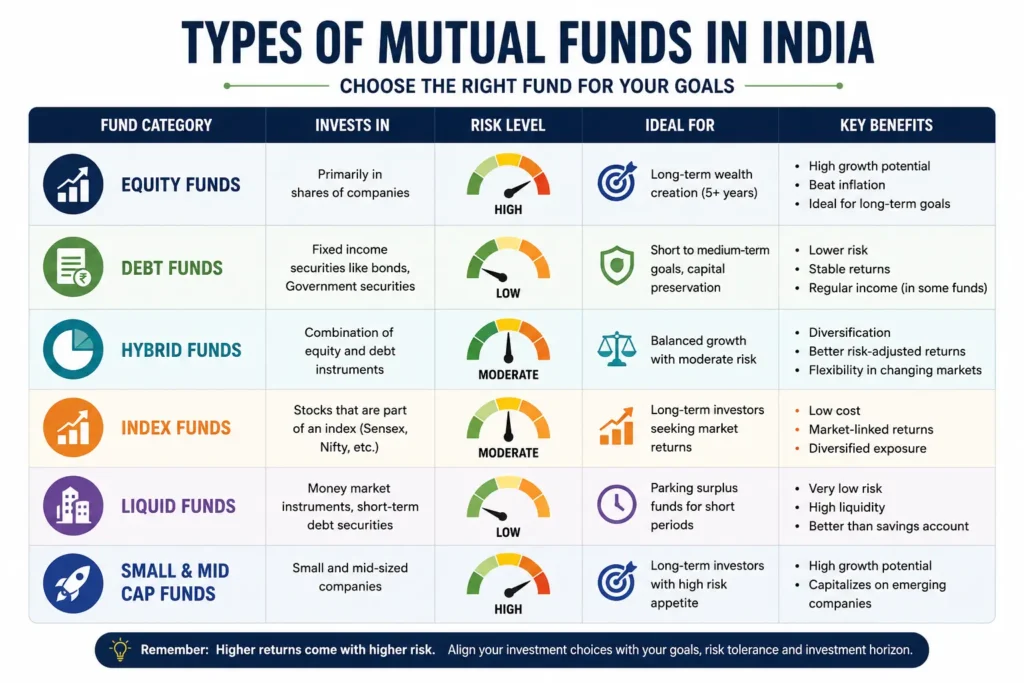
The major choices include:
- Equity funds: Primarily invest in shares and generally target long-term growth.
- Debt funds: Invest in fixed-income securities for a steadier purpose, but they are not risk-free.
- Hybrid funds: Combine equity and debt exposure.
- Index funds: Passively track an index.
- Active funds: Fund managers actively select investments.
- Passive funds: Attempt to replicate an index or predetermined strategy.
- Examine the Portfolio
Look at the fund’s largest holdings, sector exposure, number of securities and concentration. A fund holding too much of its portfolio in a few companies or sectors may carry additional concentration risk.
- Consider the Fund Manager
For actively managed funds, examine the fund manager’s experience, tenure and investment approach. A manager’s track record is as important as the particular fund’s performance and should not be treated as a guarantee of future returns.
How to Evaluate Mutual Fund Performance
Knowing past returns is just one piece, not the whole puzzle when identifying the best mutual funds to invest in India.
Expense Ratio
The expense ratio, or Total Expense Ratio (TER), represents the costs associated with running and managing a mutual fund scheme. These expenses are reflected in the scheme’s NAV. AMFI notes that TER has a direct bearing on NAV and that investors can compare the disclosed TER of schemes when evaluating funds. Lower costs can be particularly valuable over long periods because the savings can remain invested and compound. However, the cheapest fund is not automatically the best fund; cost should be evaluated alongside performance, risk and portfolio quality.
CAGR
Compound Annual Growth Rate, or CAGR, shows the annualised rate at which an investment grew over a particular period. For example, instead of comparing only the total amount earned over different time periods, CAGR can help investors compare annualised growth over comparable periods.
Rolling Returns
Rolling returns calculate returns across multiple overlapping periods. They can provide a better understanding of consistency than examining one specific start and end date. For example, looking at several three-year rolling-return periods can reveal whether a fund has consistently performed well or whether its overall long-term result was driven by one unusually strong period.
Benchmark Performance
Every fund should be evaluated against an appropriate benchmark. If an actively managed fund fails to add value relative to its benchmark repeatedly after considering costs, you should probably look somewhere else.
Sharpe Ratio
The Sharpe ratio is a measure of the return generated for the level of risk taken.
A higher Sharpe ratio is generally better, but don’t obsess over this factor alone. Check other metrics as well, and evaluate them over an appropriate period.
Standard Deviation
Standard deviation measures how widely a fund’s returns have fluctuated. A higher figure generally indicates greater volatility.
AUM
Assets Under Management, or AUM, represents the amount of money managed by a fund. A large AUM can provide useful context, but it should not be used as proof that a fund is superior.
Riskometer
The Riskometer provides a standardised indication of the risk associated with a mutual fund scheme. Investors should use it alongside their own risk tolerance rather than treating it as a substitute for analysis.
How to Compare Mutual Funds
The most meaningful comparisons are usually between funds belonging to the same category.
For example, comparing a small-cap fund with a debt fund purely on their five-year returns would not provide a meaningful assessment because they have different objectives and risk characteristics.
When comparing two similar funds, examine:
- 1-year, 3-year, 5-year and longer-term performance
- CAGR
- Rolling returns
- Benchmark performance
- Expense ratio
- Sharpe ratio
- Standard deviation
- AUM
- Portfolio diversification
- Fund manager
- Riskometer
- Exit load
When comparing mutual fund returns, never grab the fund with the highest number, full stop. Ask how and why the return was generated, how much risk was taken and whether the fund was consistent in delivering competitive results.
Active vs Passive Mutual Funds
Active funds depend on fund managers to select securities and construct the portfolio. Their objective is generally to outperform an appropriate benchmark, although there is no guarantee that they will do so. Passive funds generally attempt to replicate the performance of an index. Because the same level of active security selection is not required for these funds, their costs can often be lower. If you are looking for something simple and still want broad market exposure, go for passive index investing. Investors who prefer professional active selection may consider actively managed funds. The right choice depends on the investor rather than a universal rule.
SIP vs Lumpsum: Which Is Better?
SIP and lumpsum are investment methods rather than separate mutual fund categories. With a SIP, investors contribute a fixed amount periodically. This can make investing easier for people receiving regular income and helps create an investment habit. With a lumpsum investment, a larger amount is invested at once. This may be appropriate when an investor already has a substantial surplus available, but the entire investment is exposed to the market conditions at the time of investment. Neither method guarantees better returns. The choice should depend on the investor’s cash flow, financial goal and circumstances.
Direct Growth vs Regular Growth Mutual Funds
Direct and regular plans generally belong to the same mutual fund scheme and have the same underlying portfolio and fund manager, but they differ in distribution arrangements and expenses. AMFI explains that direct plans do not involve a distributor and therefore have a lower expense ratio than regular plans. For investors who are comfortable researching and managing their own investments, a direct plan may be worth considering because lower expenses can improve the amount that remains invested over the long term. The Growth option generally allows gains to remain invested rather than being periodically paid out as distributions. Investors should nevertheless check the current scheme documents and tax treatment before making a decision.
Important Factors to Consider Before Investing
Investment Horizon
Always match the fund to the time you can stay invested. Longer horizons can make it easier to tolerate short-term equity volatility, but they do not remove risk.
Risk Tolerance
Choose a fund whose fluctuations you can realistically withstand. A theoretically high-return investment is not useful if you panic and exit during a market correction.
Diversification
Diversification can reduce dependence on one company, sector or market segment. However, owning too many similar mutual funds can create unnecessary overlap.
Exit Load
An exit load is a charge that may apply when investors redeem units within a specified period. Check the scheme’s current exit-load conditions before investing, particularly if you may need the money soon.
Taxation
Tax treatment differs depending on the type of mutual fund, holding period and prevailing tax rules. Since tax regulations can change, investors should verify the applicable rules when making an investment decision.
Common Mistakes to Avoid
The worst of all is picking the highest performer from last year and thinking that’s the golden ticket. Markets move in cycles, and last year’s winner may not remain the leader. Other common mistakes include investing without understanding the Riskometer, comparing unrelated fund categories, selecting too many funds, ignoring costs and exit loads, stopping SIPs because of short-term market declines, and investing money needed for near-term expenses into high-volatility equity funds.
Investors should also avoid constantly checking their portfolios and making decisions based on every market movement. AMFI advises investors against the temptation to review fund performance every time markets rise or fall significantly.
How to Build a Mutual Fund Portfolio for Long-Term Growth
A long-term portfolio doesn’t mean giant, messy portfolios. A couple of solid, diversified funds or equity-oriented funds can get the job done for most people. Add mid- or small-cap funds only if you know what you’re signing up for. If you want safety, consider hybrid or debt funds.
Allocate based on your goals, age, income, risk and other assets. Diversification should help you, not make things more complicated.
Best Mutual Funds in India 2026: Quick Selection Guide
| Investor Need | Category to Explore | What to Check |
|---|---|---|
| Beginner SIP | Broad-market index/diversified equity | Simplicity, diversification and cost |
| Long-term growth | Diversified equity | Consistency and risk |
| Large-cap exposure | Large-cap/index | Portfolio and benchmark |
| Higher growth potential | Mid-cap | Volatility and long-term performance |
| Aggressive long-term investing | Small-cap | Risk and drawdowns |
| Lower-volatility objective | Debt/hybrid | Credit and interest-rate risks |
| Passive investing | Index fund | Expense ratio and tracking difference |
Remember that this table describes categories, not guaranteed recommendations. The best mutual fund depends on the individual investor’s circumstances.
How to Use This Guide Before Choosing a Mutual Fund
Use this guide as a starting point rather than a shortcut to chase the latest top-performing scheme. First, identify your goal and investment horizon. Then consider the level of risk you can realistically tolerate, narrow down the appropriate fund category and compare similar schemes using the factors discussed above.
Before making an investment decision, review the scheme’s current documents, portfolio, costs, risk level and other relevant information. Mutual fund investments are subject to market risks, and past performance does not guarantee future results.
Frequently Asked Questions
Which mutual fund is best for beginners?
There’s no universal answer. Start with a broad, diversified index fund for long-term simplicity, but it depends on your goal, horizon and risk comfort.
How many mutual funds should I have?
There is no fixed number. A small number of well-chosen, complementary funds can be easier to understand and monitor than a portfolio containing many overlapping schemes. Focus on diversification and purpose rather than collecting fund names.
Is SIP better than lumpsum investment?
Neither is automatically better. SIP can be convenient for investors with regular income and encourages disciplined investing, while lumpsum investing may suit someone who already has a sizeable amount available to invest. The appropriate method depends on your cash flow, goal and circumstances.
What should I check before choosing a mutual fund?
Start with your financial goal, investment horizon and risk tolerance. Then compare similar funds based on factors such as long-term performance, rolling returns, benchmark performance, expense ratio, portfolio diversification, risk measures and the fund’s investment strategy.
Conclusion
The best mutual funds to invest in India in 2026 are not necessarily the funds with the highest recent returns. A better approach is to begin with your financial goal, determine your investment horizon and risk tolerance, select an appropriate fund category and then compare schemes using performance, rolling returns, benchmark performance, expense ratio, Sharpe ratio, standard deviation, AUM, portfolio diversification and fund-manager experience. For beginners, SIPs and diversified funds can provide a relatively simple way to start investing. For long-term investors, equity and index funds may offer opportunities for wealth creation, while debt and hybrid funds can play different roles depending on risk and financial objectives.
Ultimately, the goal is not to find a fund that performed best yesterday. It is to choose an investment that you understand, that fits your financial plan, and that you can stay invested in through different market conditions.
For more guides and updates on finance, explore our personal finance and investment topics for students section!